1. The risk register that says nothing
You know the list. At the top: "Cybersecurity", below it "Tight labour market", "Outdated IT", "Laws and regulations" and "Reputation". They were there last year too, in the same colours: two red, three orange. The board nods. Management takes note, and twelve months later the same list is discussed again. Yet nobody has done anything wrong. The risk register is up to date, the scores have been set and every action has an owner. There is a sense that everything is 'done'.
These are topics, not yet worked-out risks. It is the start of an analysis that was never carried out.
That analysis is about three questions: what exactly can happen, through what, and what does it do to us? A risk register like this does not ask for that. It asks for a name and two numbers.
Five ways a line in the risk register stays vague
Put a risk register next to you and read the lines one by one. In many risk registers, what is written falls into one of five forms.
| Form | How it appears in the risk register | What it actually is |
|---|---|---|
| Topic | "Cybersecurity", "IT", "Compliance" | An area of attention. Anything can go wrong, but the entry does not say what. |
| Problem or condition | "Outdated systems", "Staff shortage" | It is already the case. What is uncertain is what comes of it, and the entry does not say. |
| Cause | "Insufficient awareness", "Supplier dependency" | The left side of a bowtie: a route to an event that is not named. |
| Consequence | "Reputational damage", "Regulator fine" | The right side: damage after an event that is missing. |
| Negation | "Insufficient control of ...", "Strategy not achieved" | A missing measure, or an objective with "not" in front of it. |
Why that is not harmless
It starts with the score. Behind "Cybersecurity" sit likelihood 4 and impact 5, and those two numbers have to summarise ten scenarios at once that nobody has written out: a phishing email, a stolen laptop, a failed data centre, an extorted supplier. Each scenario has its own likelihood and its own damage. The 4 and the 5 come from a discussion in which every participant had a different scenario in mind. So a finer scale does not make the score more accurate. It remains false precision.
Then the measures. Any measure fits behind a topic, so the entry says "policy", "awareness programme" and "monitoring". Which measure stops which cause cannot be seen, and neither can which cause has been left unguarded.
The owner has the same problem. The CIO, for example, is "owner of IT risk". What does he check tomorrow? He can ask for budget and deliver a quarterly report, but without a worked-out scenario he cannot say which event he has to prevent and which residual risk he accepts.
For the auditor, such a line cannot be tested. He can establish that the risk register has been updated, that an owner is named and that the score was discussed in the management team. Whether the risk is under control he cannot establish, because there is no event to test against. The auditor can then only test the process around the risk register.
And the organisation does not learn from its incidents. After an incident you want to know which risk materialised and which measure failed. But a three-day outage cannot be traced back to "Outdated IT, orange", so the risk register and the incident continue to exist side by side.
What the risk register format does not ask
The people who fill in the risk register know more than what it says. The security manager can tell you how an attack would unfold. The controller knows which payment would slip through on a Friday afternoon. But the risk register has columns for name, description, likelihood, impact and measure. There is no place for the question "what happens at the moment it goes wrong, through what, and then what?". Formats steer thinking: a risk manager who has to fill a cell writes a heading.
Process safety, the discipline that has to prevent accidents with hazardous substances in industry, starts from the other end: at the moment things go wrong. There the analyst thinks from the night shift on a production platform: which valve, which pump, which form, which handover. Section 2 shows where that habit comes from.
If you cannot tell how the risk unfolds, it has not yet been analysed.
Three tests
Three questions establish whether a line in the risk register is a risk you can analyse as an event. Not every risk is such an event. Trends and strategic uncertainties call for other tools, such as scenarios. This paper is about the risks that can be told as an event. The three tests below show which lines in your risk register belong to them.
The first is the event test: can you attach a date and a time to it? "On Tuesday at 03:12 ransomware starts in our network" passes the test. "Cybersecurity" does not.
The second is the walk-through test: can you tell the story? What caused it, who notices first, what follows in the first hour and what in the first week?
The third is the barrier test: can you point out, for each cause, what stands in between, and for each consequence, what limits the damage?
From heading to half a bowtie
Take the line "Cybersecurity, likelihood 4, impact 5, red" and rewrite it along those tests. The event becomes: ransomware starts in our network. That can happen along several routes. An employee hands over credentials after a phishing email, an attacker exploits an unpatched vulnerability in the VPN, or the service provider that may log in to our systems is itself hacked. Damage follows as well: core processes stand still for days, recovery is expensive and the regulator may open an investigation.
That leaves one event in the middle, with the causes on the left and the consequences on the right. That is half of a bowtie, the drawing shaped like a bow tie that this paper is about. The other half is the barriers: whatever stands between a cause and the event, or between the event and the damage. Those barriers were developed in the process industry, where accidents cost human lives.
2. Where the bowtie comes from: risk analysis in matters of life and death
On the evening of 6 July 1988, on the Piper Alpha production platform in the North Sea, the night shift relieves the day shift. Around ten in the evening the platform is on fire.
Unlike the lines in Section 1, this is a risk you can retell minute by minute.
Piper Alpha along the bowtie
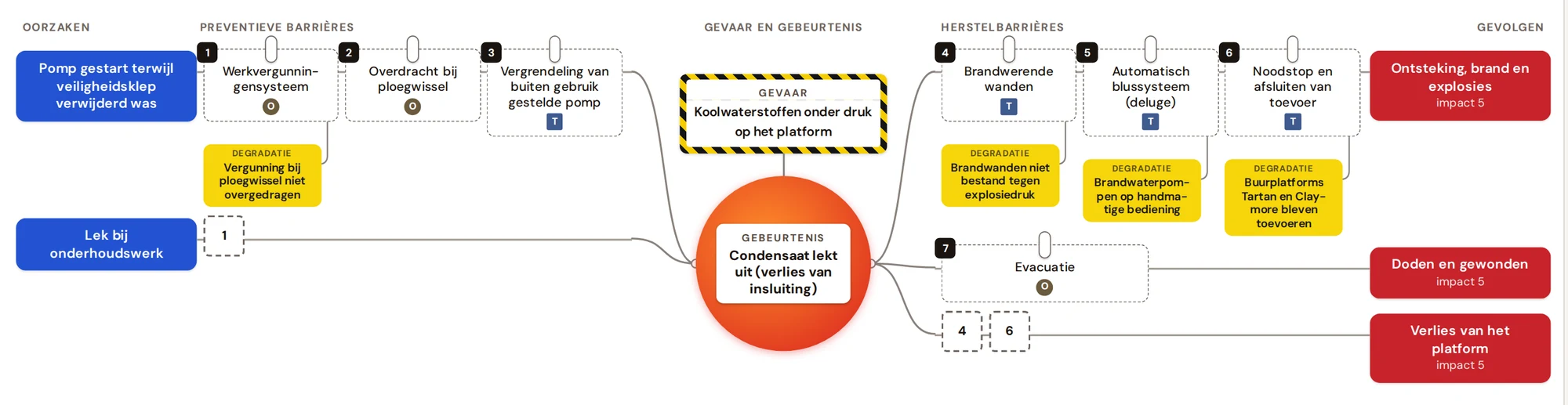
At condensate pump A, the pressure safety valve, the valve that opens when pressure rises too high, had been removed for maintenance. In its place sat a blind flange, a closing plate, which was not leak-tight under operating pressure. The permit for the valve work was kept in a different place from the one for the pump, and the permit system did not link the two. As a result, the night shift never saw it [1]. When pump B failed, the night shift started pump A. That is the left side of the bowtie: a cause that can be narrated step by step.
Condensate leaked out. That is the top event, called loss of containment in process safety: the hazardous substance is outside the installation and the crew no longer has control over it. What came next is on the right as consequences. The condensate ignited, fire and explosions followed, people died and were injured and the platform was lost.
To the left of the leak there should have been three barriers: the permit-to-work system, the handover at shift change and a physical lock-out of the pump. The first two existed and failed; a lock-out that blocked the pump until the work was done was not there. The permit system was meant to prevent a pump under maintenance from being started. It failed because the permit for the valve work did not reach the night shift. In the bowtie that circumstance is an escalation factor. The figure also shows a second cause, a leak during other maintenance work; only the permit system stands in front of it, with a dotted number.
On the right stood the barriers that should have limited fire and escalation. Between the modules were fire walls, which could not withstand the pressure of an explosion. The trade calls walls that can do so blast walls. The automatic firefighting system (deluge) got no water: the fire pumps were set to manual control, a common precaution to protect divers in the water from being sucked in [1]. The emergency shutdown was meant to cut off the supply to the platform. It reached no further than the platform itself: the neighbouring platforms Tartan and Claymore kept feeding oil through the connected lines, which fed the fire. That is the escalation factor on the barrier "emergency shutdown and isolation of supply". Later the fire caused the gas pipelines arriving at the platform to rupture, and their contents caused the heaviest explosions. Evacuation was the last barrier, on the line to deaths and injuries.
Six of the seven barriers existed. Whether they would work that evening had not been shown.
167 people died.
The conceptual framework
In 1990, in his book Human Error [2], James Reason described how accidents arise from failures in successive layers of defence; the model later became known as the Swiss cheese model. In that model each barrier is a slice of cheese with holes. One slice does not stop everything and a stack of slices does, until the holes line up at a bad moment. An accident is then a series of barriers that each leaked in their own way, and the operator who performed the last action is only one link.
That is also how it went on the Deepwater Horizon drilling rig. In 2010, 11 people died there after, among other things, three things went wrong in succession: the cement did not seal the well, the negative pressure test that should have shown this was misread, and the blowout preventer, the valve that should have closed the well as a last resort, did not close it [5]. The pressure test is the most instructive: the evidence that the barrier did not work was there, and was reasoned away.
The drawing of the bowtie is older than Reason's model, but where the bow-tie shape comes from is poorly documented. The literature usually attributes it to notes from an ICI course on hazard analysis at the University of Queensland, from 1979 [6]. The inquiry into Piper Alpha led by Lord Cullen did not appear until 1990 [1]. For offshore installations, Cullen recommended a regime based on the safety case, a concept that already existed: the operator of an installation demonstrates that the major hazards are identified and controlled. Shell is generally named as the company that then, in the early 1990s, made the bowtie the standard for that justification.
Measuring what is easy
In an explosion at the BP refinery in Texas City in 2005, 15 people died. The investigation by the US Chemical Safety Board [3] and that of the Baker panel [4] both found that the emphasis on personal safety figures, such as slips and trips, masked what was happening to process safety. The figures looked good while the process barriers were deteriorating. Section 5 returns to that lesson: an indicator must tell you whether a barrier works, and what is easy to count usually does not.
What a barrier is
From these investigations comes a way of thinking that is stricter than "we have a measure". A barrier must be able to interrupt a scenario, and there must be evidence that it still does so today. So last year's audit is not that evidence.
That evidence has to be recent, because barriers expire. That happens gradually and invisibly, through escalation factors: an exception that stays in place, a test that is postponed, a system that temporarily goes to manual. The standard work on the method is Bow Ties in Risk Management by CCPS and the Energy Institute from 2018 [6]. It speaks of a degradation factor, also known as an escalation factor. The Bowtie app, which the figures in this paper come from, follows that with the label "Degradatie".
Where no lives are at stake
With corporate risks, lives are usually not directly at stake, and that makes it easy to stay vague. A board of inquiry that asks, barrier by barrier, why it did not work rarely comes, and so the question is rarely asked in advance either.
3. The anatomy of the bowtie
You read a bowtie from left to right, and the reading direction is time. On the left is what precedes the event: the causes and what stops them. In the middle sits the knot, the moment at which the organisation loses control. On the right is what comes after: the consequences and what limits the damage. Above the knot hangs the hazard, the source of potential harm that you want to control in this bowtie.
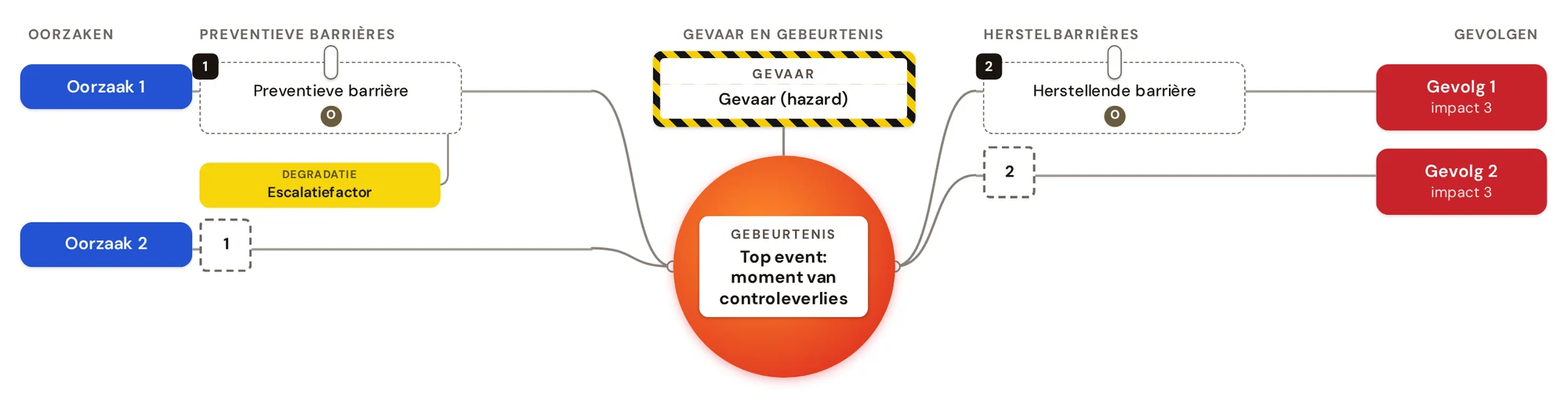
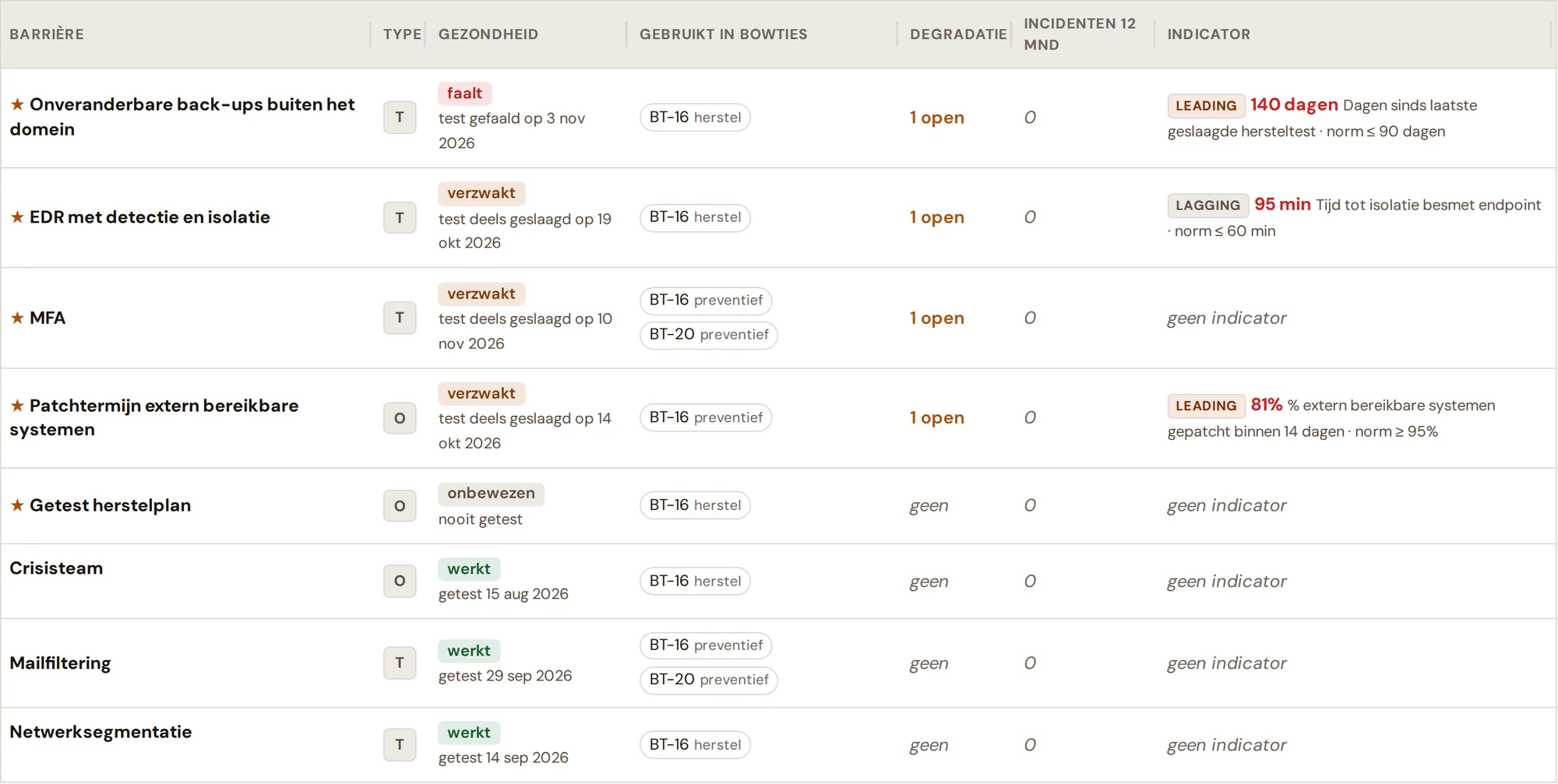
The figures in this article come from the Audirium Bowtie app and use that app's (Dutch) labels. "Gevaar" is the hazard, "Gebeurtenis" the top event and "Degradatie" the escalation factor. A T stands for a technical barrier and an O for an organisational one. A star marks a barrier that the workshop designated as critical: if it fails, a path lies open or recovery is not possible. A dotted number means that the same barrier also appears on a second line.
Eight components
Each component comes with a definition and a rule. The rule is there to keep vagueness out of the drawing.
| Component | Definition | The rule that keeps vagueness out |
|---|---|---|
| Hazard | The source of potential harm: what you need to control. | Concrete enough to point at, not a topic. "The business-critical IT environment the core processes run on" qualifies, "IT" is too broad. |
| Top event | The moment of loss of control, before the damage is complete. | Passes the event test: a date and a time can be attached to it. |
| Cause (threat) | A specific route to the top event. | A credible route that, without barriers, leads to the top event. |
| Consequence | Concrete damage after the top event. | State what then happens: customers leave, the regulator intervenes. "Reputation" is too vague. |
| Preventive barrier | Stops a cause before the top event. | You can point out which part of the route it interrupts. |
| Recovery barrier | Limits the damage after the top event. | Also works when all prevention has already failed. |
| Escalation factor | The circumstance through which a barrier fails. | Specific per barrier. "Human error" in general does not count. |
| Escalation barrier | Stops that escalation factor. | Keeps the barrier standing. Policy, training and supervision belong here. |
Where do you place the knot?
The hardest choice is the position of the top event. If the knot sits too early, for example at "an employee receives a phishing email", no control has been lost yet. Such an email arrives every day. There is little to draw to the left of the knot and the entire defence ends up on the right in one heap.
If the knot sits too late, at "all systems encrypted", you have chosen a consequence. Everything then becomes prevention, the left side fills up and the barriers that should stand between intrusion and damage, detection and intervention, no longer have a place of their own. They are then also the first to be forgotten.
The knot also depends on the question you want to answer. A data breach can be a top event of its own: loss of confidentiality is a different loss of control from loss of availability, with its own causes and its own consequences. So choose the question first and then the knot.
For ransomware, two variants are defensible. The first places the knot at "an attacker has access to the internal network". To the left is then everything that prevents intrusion, to the right everything from detection to recovery. The second places it at "ransomware is executed in the network". That moment comes before the encryption is complete, so you can still intervene. This paper uses the second variant.
The discussion about the knot is often the most useful half hour of the workshop. The participants then discover that, behind the same heading, each had a different event in mind. The security manager, for example, thought of intrusion, the director of a business that has come to a standstill and the privacy officer of stolen files.
Which measure counts as a barrier
In a risk register, everything the organisation does is called a measure. In a bowtie, only what can interrupt a scenario stands on the line; policy, training and awareness keep barriers upright and therefore sit as escalation barriers with the escalation factors. Section 5 works out that difference.
4. What the bowtie shows and the risk register does not
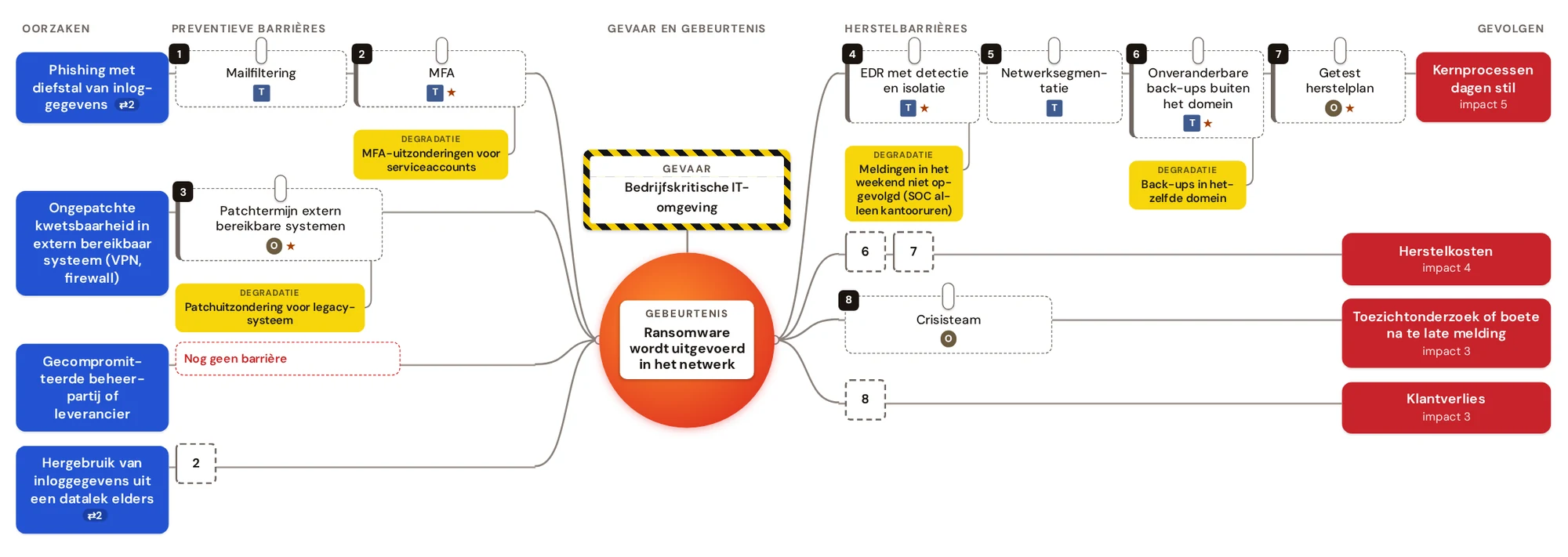
The red line from Section 1 is drawn out here. The hazard is the business-critical IT environment the core processes run on: if it goes down, the business stops. The top event reads: ransomware is executed in the network. At that moment encryption has begun but is not yet complete.
On the left are four causes. An employee falls for a phishing email and their credentials are stolen. An externally reachable system, a VPN or a firewall, has a vulnerability that has not been patched. A service provider or supplier with access to the network is itself compromised. Or an employee reuses credentials that were leaked in a data breach elsewhere.
Each cause is the start of a route, not a complete attack. Usually more steps follow before the ransomware starts: escalating privileges, moving through the network, finding the backups. They are not always needed, because ordinary user rights already allow a lot to be encrypted. The drawing condenses those steps into the line to the top event. On that stretch, between getting in and executing, this bowtie has no barrier of its own, while that is often where days pass in which detection pays off most. EDR and segmentation are drawn on the right, but do their best work in that phase already.
Opposite them stand three preventive barriers. Email filtering stops the phishing email before the employee sees it. MFA, a second factor alongside the password, makes stolen or reused credentials worth much less to the attacker. How much less depends on the form: a text-message code or a push notification can be bypassed, a key bound to the device is much harder. Patching within the deadline, in the figure simply "Patch deadline", closes the vulnerability before it is exploited. Only on the supplier path is there no barrier. There is a contract with the supplier, but a contract is not a barrier; section 5 explains why. The names describe the barrier as it is intended; whether it is actually like that follows below.
On the right are four consequences. Core processes stand still for days, recovery costs mount, the regulator opens an investigation or imposes a fine if the notification comes too late, and customers leave. The recovery barriers are EDR, software that detects suspicious behaviour on workstations and servers and can isolate an infected system, network segmentation that limits the spread, immutable backups outside the domain, a tested recovery plan and a crisis team.
Extortion with stolen data is deliberately left out. Attackers often copy the data before they start encrypting. That is a different event, loss of confidentiality, and a barrier to the right of this knot comes too late for it. In the example that theft therefore has a bowtie of its own, BT-20, with a cross-reference both ways. The workshop supplied the extortion as a consequence of ransomware, and you will come across the same in your own first bowtie.
With that, the drawing is done. Now come four questions that you cannot ask of a risk register with only names and scores.
Routes without a barrier
Go through each cause and look at what stands on the line to the top event. For phishing there are email filtering and MFA. For the unpatched vulnerability there is patching within the deadline, for the reused credentials MFA again. For the supplier there is nothing.
There is a contract with the service provider. A contract can oblige the supplier to use MFA, patch and monitor sessions, but the document itself does not stop an attacker who comes in with the service provider's account. The workshop first put it on the line; at the question whether it interrupts an attack, it dropped out. So nothing on that line interrupts an attack, and a heatmap does not show it. In the risk register, behind "Cybersecurity" stood a row of measures, and a row always looks complete.
Make the same round on the right-hand side. Against the standstill of core processes there are four barriers, from EDR to the recovery plan. Against the recovery costs stand the backups and the recovery plan, and those two depend on each other: without a usable copy there is nothing to recover. Against the regulator's investigation and the loss of customers stands only the crisis team. Those lines are thin, and they only come into view because each consequence has been given its own line.
It is there on the right, but does it work?
The old risk register mentioned almost only prevention: policy, awareness, filtering, patching. That fits the idea that an attack can be repelled. But for ransomware that is not a realistic starting point. After all, an organisation with a few hundred employees and dozens of suppliers must assume that an attacker gets in at some point. The trade calls it assume breach: count on the attacker already being inside. The weight of control then shifts to what happens after the attacker is in. How quickly does someone see it, how far can the attacker get and how quickly is the business running again?
In the bowtie there are five barriers on the right, one more than on the left. So the number is not the issue. The question is for how many of those five there is evidence that they work. Section 5 answers that and arrives at two: network segmentation and the crisis team. The backups, on which the recovery of core processes rests, are not among them.
When does a barrier fail?
The third question is about circumstances: the barriers are there, but when do they let you down?
EDR detects and reports. Isolating an infected system, however, requires an action by the SOC, the security operations centre that follows up the alerts, and the SOC is staffed only during office hours. An alert on Saturday night is therefore not read until Monday morning. That is the shift change on Piper Alpha in another sector: the information exists and does not reach the person who has to act in time.
The backups are called immutable and outside the domain, but they are managed from the same domain as the servers they are meant to save. An attacker with admin rights in that domain can then often reach the management console too, unless it has its own sign-in and its own network access. Whether they can delete the copies or shorten the retention depends on the settings, and that is exactly what the recovery test has to show. The barriers on the left have their exceptions too. MFA applies to employees, with an exception for service accounts, the accounts that systems use to log in to each other. Patching within the deadline applies to all external systems, except for that one legacy system for which the supplier no longer issues updates.
None of these exceptions is secret. They sit in an admin document, a change request or an administrator's head. In the risk register they were not recorded, because it only asks whether the measure exists.
You find escalation factors by asking one question per barrier of the person who operates it: when did it last not work, or when was it deliberately switched off? Administrators usually know straight away, because they often requested the exception themselves.
One barrier, two paths
Then look at which barrier stands on more than one line. MFA stands on two of the four paths: phishing and reused credentials, not the supplier path. That is efficient, and it is a shared dependency: if MFA drops out, both paths stand weaker. On the phishing path, email filtering remains. On the path of reused credentials nothing else stands, so the exception for service accounts weighs heaviest there.
Across bowties that pattern gets stronger. In the example MFA and email filtering also stand in the bowtie for data theft, BT-20. If the organisation also draws a bowtie for payment fraud, MFA is likely to return there too. A barrier register, a list of all barriers with the bowties in which they appear, shows which barriers carry the most weight. Those you test first. Section 6 builds on this.
The reverse is informative too. Email filtering occasionally lets a phishing email through, and that is bearable as long as MFA holds on the same path. You can test less only where the second barrier is demonstrably reliable, independent of the first and covers the whole path, and where the remaining risk is within the risk appetite. That it is drawn is not enough for that.
What you now know
Go back to "Cybersecurity, likelihood 4, impact 5, red". You now know that on the path via the supplier nothing stands that interrupts an attack. On the recovery side there is plenty in place but little has been proven. Four barriers have a known weak spot, and MFA carries two paths. No new data was collected for this, because everything in the bowtie was already known to the people at the table. The risk register just had no column for it.
To each of these findings you can attach an owner, a test and a deadline. The score has meanwhile stayed the same: likelihood 4, impact 5. The discussion about the number has given way to a list of what is missing.
The red cell only says that it is serious. The bowtie shows what you need to do: shield the supplier's access and find out why the recovery test failed.
5. Barrier quality
What counts as a barrier
A barrier must be able to interrupt the scenario. For an active barrier that takes three things: it detects that something is wrong, a decision is made and an action follows. If one of the three is missing, it is half a barrier. A dashboard that shows deviations detects. As long as nobody is assigned to watch it and intervene, it stops nothing. Passive barriers, such as a fire wall or immutable storage, do not need that chain. They work by design.
A barrier is also independent of the cause it is meant to stop and of the other barriers on the same line. A dependent measure can still help, but you do not count it as a layer of its own. It is testable, and it has an owner who can be held to account.
By that yardstick, familiar measures find a different place. Policy does not stop an attack. Training and awareness reduce the chance that someone clicks a link, but do not stop the email that is opened anyway. "Monitoring" without action is a log. A contract sets out agreements, but does not carry them out. These are supporting measures: they make barriers work, and in the bowtie they therefore belong with the escalation barriers. The training, for instance, makes sure the analyst recognises an EDR alert. The policy determines that service accounts may not log in interactively, get only the rights they need and keep their passwords in a vault. The figures in this paper show no escalation barrier. The exception for service accounts does call for one, for example a half-yearly review of all exceptions.
A procedure can be a barrier. The permit-to-work system on Piper Alpha was one: a procedural barrier carried out by people, which was meant to prevent a pump under maintenance from being started. That evening it did not work, and the Cullen inquiry found that the operation of the system was not adequately monitored in practice [1]. A barrier that depends on people and forms therefore requires evidence over time and under changing staffing, not a single moment when it worked.
Technical and organisational
Barriers differ in how they work. The figures distinguish two types. A technical barrier (T) works without a human: email filtering that blocks a message, segmentation that refuses a connection. An organisational barrier (O) relies on people and agreements, and human behaviour falls under it: the crisis team that convenes, the employee who recognises and reports a suspicious email.
Between them is a hybrid, technical-human: the technology gives a signal and a human has to act. EDR in the example is such a barrier: the software detects and reports, but the SOC has to isolate the infected system. The app knows only T and O; EDR is shown as T, and that is too favourable: the part that depends on the SOC drops out of view.
How much evidence a barrier requires depends on the ways it can fail. Technology can be misconfigured, miss an attack type or drop out during maintenance. A human adds failure modes that vary with the time of day and the workload. That is because the analyst has to be awake, see the alert among a hundred others, judge it serious enough and be authorised to shut down a server. That is four places where it can go wrong, and each of them is an escalation factor. For the auditor it follows that every human step in the barrier is a place the evidence has to cover.
Two barriers that are one
Independence is the requirement that is most often violated unnoticed in corporate environments. The backups from Section 4 are the example: managed from the same domain, they share a weak spot with the servers they are meant to save. On the drawing, the production environment and its backup are separate, while an attacker can reach both through the same management.
The same applies to two barriers that rely on the same identity service. If MFA and the backup management console both obtain their access from the same directory, a single compromised directory can disable both at once. Then they do not count as two independent barriers. Process safety calls this a common cause. The question you ask for each pair of barriers is: what has to break to disable both of them?
Health based on evidence
A barrier that is meant to be there and is independent can still fail to work. That is why every barrier gets a health status, based on evidence. Four states suffice. Works: there is recent evidence that the barrier did what it was meant to do. Unproven: it is in place, but nobody has seen it work. Weakened: it works, with a known exception or backlog. Fails: a test or an incident has shown that it does not stop the scenario, measured against the standard set in advance for that barrier.
"Unproven" is the honest default. Expect many controls to get that label at a first assessment: there is a description and an owner, and nothing else. That is an uncomfortable outcome, and a useful one. It shows, per barrier, which evidence is still missing.
That evidence comes from tests, incidents and indicators. With indicators, Texas City showed how it goes wrong: the figures that were easy to collect said nothing about the barriers. A good indicator therefore measures whether the barrier works. The app labels indicators as leading or lagging. A leading indicator measures in advance the conditions under which the barrier can work and warns when they deteriorate; a lagging indicator measures afterwards what has happened.
For patching within the deadline, the indicator is the percentage of externally reachable systems patched within the deadline. That indicator measures compliance with the standard, but it does not say whether the deadline is short enough to stay ahead of an attacker. For the backups, the indicator is the time since the last successful recovery test. Successful means that the core systems were back within the required recovery time (RTO) and with acceptable data loss (RPO). The standard in the example is 90 days; how often it needs to be depends on how fast the environment changes and what an outage costs. In the example, the last successful recovery test is 140 days old, well outside that standard, and the test in early November failed. For EDR, the time between detection and isolation counts. The number of employees who have completed the awareness training is, in that sense, the slips and trips of information security.
For the ransomware bowtie the assessment comes out as follows. Email filtering, network segmentation and the crisis team work: all three were tested successfully in the past three months, the crisis team on 15 August, segmentation on 14 September and email filtering on 29 September. "Works" here therefore means: worked in that test. An indicator that shows it between two tests does not yet exist in the example. MFA, patching within the deadline and EDR are weakened. For MFA it is the exception for service accounts, for EDR the follow-up outside office hours. Patching has two: the legacy system and a backlog, since 81 percent of external systems are patched on time against a standard of 95. The immutable backups fail: the recovery chain did not pass the last test. Whether the cause lies in the copies themselves, the procedure or something the recovery depends on has yet to be established, and until then you cannot rely on them. The tested recovery plan is unproven: despite its name, no test of it has been recorded. Five of the eight barriers have no indicator yet; their verdict rests on a single test or, for the recovery plan, on none at all.
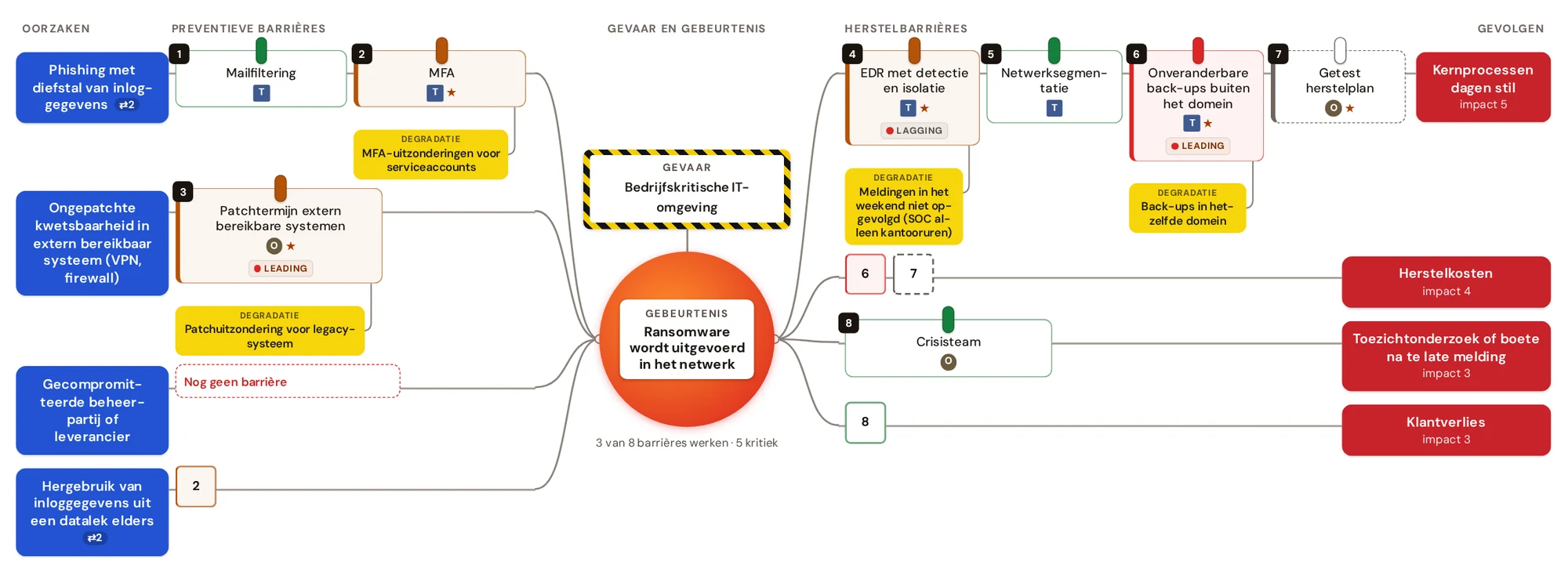
A barrier only counts when you can show that it works.
6. From drawing to assurance
The barrier is the audit object
You cannot test a risk; you can test a barrier. Barriers are the controls you test, and the bowtie tells you for each control why it is there: which cause it stops or which consequence it limits.
The familiar distinction between design and operating effectiveness thereby gets sharper questions. On design: is the barrier there, can it interrupt the scenario and is it independent of the other barriers on the same line? On operating effectiveness: does it work now? You answer that last one with the indicator, with a test and with the incident history. A recovery test of the backups that you attend yourself says more than twelve monthly reports with a green tick.
The test looks different for each type of barrier. A technical barrier you set off: send a test email with known phishing traits through the filter, or open a connection that segmentation should block. With the hybrid you also test the human, so with an alert on a Saturday evening rather than on an announced Tuesday morning. With an organisational barrier that relies on behaviour, you test with a simulated phishing round and observe over a longer period: what share of the real and the simulated suspicious emails was reported, and how many of those within the hour?
Planning on what carries the most weight
An audit plan that follows the heatmap starts with the red cells. With a barrier register it can be different. Weigh for each barrier how serious the scenarios it stands in are, in how many bowties it returns and whether it is the only one on a path. What comes out on top carries the most weight. If such a barrier is also unproven or weakened, it goes to the top of the plan. An audit of MFA covers, in the example, two paths in the ransomware bowtie and also touches the bowtie for data theft. That gives risk-based audit planning a justification you can show the audit committee: this control, because two paths rest on it and it has a known weak spot.
It can also free up capacity. If a control, within a fully drawn event, stands on no line at all, the question is why it is tested every year. For what has not yet been drawn, the bowtie says nothing.
Mapping incidents back
Every incident and every near miss you map back onto the bowtie. You then ask: which cause was it, which barriers held and which failed? After a year you see a history per barrier, and it is more reliable than a self-assessment.
Do it soon after the incident, while those involved still remember who saw what and at what time. For a major incident the full picture only comes after the investigation; record what is already known first.
The near miss is the most valuable here. A phishing email in which an employee entered their password and the attacker then got stuck on MFA is, in the risk register, a non-event. In the bowtie it is free evidence: email filtering let the email through, the employee did not recognise it, MFA held. "Held" is evidence for that one situation, date and all. Added up over time, it becomes an indication that the barrier works. Conversely, one email let through is not a failure of the filter. Every filter has a margin of error, and only the pattern over months says something about the barrier as a whole.
Three lines, one drawing
The bowtie divides the work over the three lines [8] without needing a new meeting. The first line owns and operates the barriers: the administrator patches, the SOC follows up alerts, the process owner rehearses the recovery plan. The second line maintains the standard for bowties, the barrier register and the indicators, and ensures that a barrier in one bowtie means the same as in another. The third line tests two things: whether the barriers work, and whether the bowtie is right. For the second question it looks at whether the knot is in the right place, whether the causes are complete and whether there is a supporting measure on a line where a barrier belongs.
The third line has long asked that second question; the bowtie makes it concrete. An auditor who tests only the barriers on the drawing misses the cause that nobody drew. So lay the bowtie next to the incidents in your own sector and next to the threat reports the organisation already receives, and see which route is missing.
For the audit function this connects to the Global Internal Audit Standards of 2024. Standard 9.4 asks for a risk-based audit plan and Standard 13.2 for a risk assessment per engagement. The bowtie provides input for both but does not replace them. The barrier register helps to justify the choice of audit objects, and the bowtie of one event is a starting point for the risk assessment of an engagement, including a first list of controls you want to test.
What the board hears
Reporting to the board changes with it. "Cybersecurity remains red, likelihood 4, impact 5" leaves a director empty-handed: it was red last quarter too. Compare that with: "Of the eight barriers against ransomware, three demonstrably work. Three are weakened, one is unproven and one fails: the backups, on which the recovery of core processes rests. The path via the supplier has no barrier." A board can ask a question about that, attach a deadline to it and come back to it a quarter later.
The heatmap can stay in the report as a table of contents. The director who presses on a red cell gets to see the bowtie and the state of the barriers.
The auditor then tests whether the barrier works at the moment it matters, instead of whether the risk register has been updated.
7. From workshop to finding
You make a first version in two hours; plan for a second session for escalation factors and owners. Around the table sit the process owner, IT management, security, crisis management and the second line. The auditor is an observer or facilitator. If he facilitates, he asks the questions and leaves the answers to the table: the bowtie belongs to the first line. Facilitating is an advisory engagement. Record it as such, and have the test of whether the bowtie is right done at a later audit by a colleague who was not at the table. That keeps the objectivity the Standards require (Principle 2, Standard 2.2) [7].
The order is fixed. First the knot, and half an hour may go on that. Then the causes, each tested on whether it credibly leads to the top event without barriers. Then the consequences, in concrete damage. After that the barriers on each line. In the second session, the question follows per barrier of what can take it out, and each barrier gets an owner with a name. A department does not suffice for that.
Two practical rules help. One person draws, on a screen that everyone sees, so that every addition is immediately open to discussion. And a participant who names a barrier says on which line it stands. That second rule removes the general measures: "we have an information security policy" has no line.
In workshops the discussion often gets stuck on whether something is a cause or an escalation factor. The rule of thumb: what can directly cause the top event is a cause, what disables a barrier is an escalation factor. Understaffing of the SOC, for example, does not cause ransomware. It does disable the follow-up of EDR alerts and is therefore an escalation factor.
After the workshop comes the assessment of the barriers on evidence. That is desk work and field work: requesting the indicator, attending a test, mapping back the incidents of the past year. The ransomware bowtie then yields findings like these three.
Supplier access without a barrier. The service provider logs in directly to the servers with its own account. On that path there is no barrier, only a contract, and whether it is complied with has not been tested.
This matters because the path from a compromised supplier to the top event is open. Nothing stands there that can see or interrupt a session.
Recommendation: route all supplier access through a jump host, a managed intermediate server through which every administration session runs, with MFA and per-session access on request. Monitor the sessions so that someone can interrupt a suspicious session, and close the direct route.
Backups fail the recovery test. The recovery test in early November failed. The last successful test is 140 days old, well outside the standard of 90 days. The backups are managed from the production domain.
This matters because the recovery of core processes rests on this barrier, and because it shares a common cause with the attack.
Recommendation: manage the immutable copy outside the domain, with its own accounts, and demonstrate its operation every 90 days with a recovery test of the core systems, assessed against the required recovery time and the acceptable data loss.
EDR follow-up outside office hours. EDR detects and reports on all endpoints. Isolation requires an action by the SOC, which is staffed only during office hours.
This matters because outside office hours, every night and all weekend, the barrier detects without acting.
Recommendation: enable automatic isolation for the most severe category of alerts and arrange follow-up outside office hours, internally or with a service provider. Measure the time to isolation as an indicator.
Put these three next to a finding in the old style: "the risk register was not updated in time". The recipient of that finding updates the risk register. The recipient of these three knows which attack route is open, why that matters and what to change.
8. Pitfalls
The method goes wrong in six predictable ways.
The top event is a consequence. "All systems encrypted", "fine" and "reputational damage" are chosen as the knot because they were in the risk register. The whole drawing then shifts to the left and the recovery side stays empty. Put the knot at the moment of loss of control, and move the consequence to the right. A useful check: is there still something to the right of the knot that the organisation can do? If not, it is too late.
The causes are too generic. "Human error", "cyberattack" and "insufficient capacity" are the headings from Section 1 in a new drawing. Any barrier fits behind such a cause, and so none does. Keep asking until there is a route: who does what, with what, and why does that lead to the top event? "Human error" then becomes: an administrator pushes a change to the production firewall without a second pair of eyes.
Supporting measures stand on the line. In the first half hour a workshop mainly produces policy, general procedures and training. Write them down and move them to the escalation barriers. What remains on the line is the actual number of barriers, and it is smaller than the participants expected. Let the participants count that number themselves.
The bowtie follows the department. "The bowtie of Finance" or "the bowtie of HR" is a risk register in a different shape. A bowtie belongs to one event, and that event runs through several departments. That is also why five functions sit at the table. The process owner of the event owns the bowtie. The barriers each keep their own owner, in whichever department that is.
There are too many bowties. An organisation that wants to draw all sixty of its risk register risks will probably have sixty half-finished ones after a year. So start with the five events that matter and make those complete, with owners, indicators and evidence. The other lines stay in the risk register until there is a reason to draw one out, for example an incident or a question from the regulator.
It is drawn and not maintained. A bowtie without indicators ages as fast as the risk register. The drawing on the meeting-room wall then still shows the barriers as of the day of the workshop, without last month's exception. Maintenance means that the health of each barrier changes when the evidence changes, and that an incident is mapped back within a week.
9. How to start, and when not to
Start with one top event that keeps the board awake. Often that is ransomware, a major payment fraud or the failure of a supplier on which the primary process runs. Pick one, and pick the event on which opinions at the board table diverge the most.
Hold a two-hour workshop on it with the five functions from Section 7, and schedule the second session straight away. Then assess the barriers on evidence and accept that a large part will be unproven. Report that as it is. Collecting evidence takes more time than the workshop. Plan it in advance, with an end date, otherwise the first bowtie remains a drawing. Only with the second and third bowtie does the barrier register across bowties emerge, and with it the list of barriers that carry the most weight. From that moment the audit plan can lean on it.
You do not have to throw away the old risk register. It remains usable as an inventory of topics. What changes is that a bowtie gets attached to the lines at the top, and in the report the state of the barriers appears next to the colour. The score stays as a ranking; it just no longer decides what you are going to do.
When not to
There are three situations in which a bowtie is not worth the effort.
The first: risks that are at heart a quantitative problem. Market risk and interest rate risk first need a model, scenarios and limits. A bowtie around a limit breach can complement that.
The second: trivial risks. An event with small damage that can be recovered quickly and completely does not deserve a workshop with five functions.
The third is the most important. If nobody is willing to have barriers tested, the bowtie is just a better drawing, and you know no more than before. The method derives its value from evidence. An organisation that does not want to do the recovery test because it might fail is simply left with a second list.
The drawing itself also has limits. It draws each cause as a line of its own, and an accident that only arises because two things coincide is poorly shown: on Piper Alpha pump B failed while the valve of pump A was missing. For such a coincidence the fault tree is the better instrument. The separate lines also suggest that barriers are independent, while Section 5 showed that you have to test this. And the bowtie does not calculate. How many barriers are enough is worked out with LOPA (layer of protection analysis). IEC 31010 describes these techniques side by side [9].
Sources
[1] Cullen, W.D. (1990). The Public Inquiry into the Piper Alpha Disaster. London: HMSO.
[2] Reason, J. (1990). Human Error. Cambridge: Cambridge University Press.
[3] U.S. Chemical Safety and Hazard Investigation Board (2007). Investigation Report: Refinery Explosion and Fire, BP Texas City. Report No. 2005-04-I-TX.
[4] Baker, J.A. et al. (2007). The Report of the BP U.S. Refineries Independent Safety Review Panel.
[5] National Commission on the BP Deepwater Horizon Oil Spill and Offshore Drilling (2011). Deep Water: The Gulf Oil Disaster and the Future of Offshore Drilling. Report to the President.
[6] CCPS & Energy Institute (2018). Bow Ties in Risk Management: A Concept Book for Process Safety and Other Industries. Hoboken: Wiley.
[7] The Institute of Internal Auditors (2024). Global Internal Audit Standards. In effect since 9 January 2025.
[8] The Institute of Internal Auditors (2020). The IIA's Three Lines Model: An Update of the Three Lines of Defense.
[9] IEC 31010:2019. Risk management. Risk assessment techniques. Geneva: International Electrotechnical Commission.